Sunday, March 25, 2012

Maddie's Re-post from week# 4 with the pictures!


Hi! Sorry my images didn't work last week.  Here is what I was supposed to post! Sorry!!


I felt that reading The Lorax as a pop-out book was successful because it grabbed the students attention more so than a 2-D book.  Also, many of the students saw the film in 3-D which was a nice compliment to the 3-D book.


If I could re-read the book to the students, I would try to improve by looking at the students more to notice their reactions.  I think I only looked at the book while reading.

I think that the discussion went well overall.  The biggest class management issue we have is getting students to not have side-conversations while others are speaking.  Maybe we can prevent this by creating and going over class rules with the students.  Also, maybe side conversations are a sign that the discussion isn't engaging enough, so perhaps we can find ways to grab everyone's attention, not just the students who enjoy volunteering.  In this discussion, we were able to talk about the importance of preserving trees, how humans and trees are similar living beings, and how humans benefit from trees.

I was particularly impressed when Beth told the class that humans and trees are similar because we both have feelings.  I never thought about trees having emotions before.  She explained that trees are happy when they know that they are helping others and providing homes for animals.  They are sad when humans mistreat them.

I thought that the yoga tree poses were successful.  All the students were engaged, even the boys, which was a relief.  Surprisingly, many of the students were already familiar with yoga.  Joey was able to tell us that tree pose helps with balance.  Another student mentioned that it helps with focus and concentration.

Ez rocking the tree pose!

Briana shared with the class that if you focus on something not moving on the ground, it helps with balancing.

Krista!

It was really nice to have the students do the tree pose near many living trees.


 Briana and Ben!

Marisa knew a yoga pose called the "root pose" which tied in with our tree theme! She demonstrated for the class.


After students learned the traditional yoga tree pose, they learned about performance art and got to create there own tree pose.  Kaitlyn and Susie collaborated by joining together!


Briana said that her feet and legs were the roots, her torso was the trunk, her arms were the brances, and her fingers were the sticks/stems

The group created a large collaborative tree by joining bodies together. Their outstretched arms and Joey in the middle with arms in the air created uplifting branches.


During snack time, I introduced artists Judy Pfaff (left) and Mary Engel (right) to give examples of mixed media sculpture.  I think the students enjoyed seeing pictures of their work and they were able to familiarize themselves with the idea of using a variety of objects and material to create a piece.  However, I doubt they left the class remembering the artists name.  This wasn't a huge aspect to our lesson, just a way to explain mixed media sculpture.

I think it was successful having so many supplies to choose from, because the kids were very enthusiastic and eager to use them all.  Providing students with a variety of options enables creativity and an endless amount of possibilities.


While the students worked, I really tried to make an effort to walk around to each student and listen to the meaning behind their work.  I tried to write down key points to each student.  For next time, I need to remember to bring a notepad, because I tried keeping track of everyone on the back of my lesson plan, which became messy and disorganized.  I was unsuccessful with reaching to all the students because I was unable to talk with Kaitlyn and Beth before it was time to clean up.  I need to work on better time management with that. 

STUDENTS WORK FROM THIS LESSON:

Rouwa made a Percy Jackson Tree.  She is currently reading The Lightening Thief and based her tree off this book.  Whoever visits her tree can punch in a card number to have a hard cover book come out.  Percy Jaskson is on top with a lightening bolt.
 Rouwa also made a Kitty Tree.  This tree helps people take care of their pets (especially kitties).  Anyone can ask the royal kitty on top of the tree for anything their pet needs.  The kitty will whip people who were naughty all year (especially people who were naughty on Christmas) with its tail.  It will also whip bad people who steal money.


Susie's tree is an auto-transporter.  It can transport people to anyone in the world or galaxy.  The tree will land on anyone's head that the person inside wants to see.  If someone decides to visit the moon, it will provide that person with an extra comfy space helmet!  The shiny string is the control for entertainment because it acts as a guitar string.  The beads are the battery pack and by sliding up and down the pipe cleaner, they create enough energy for the auto-transporter tree.  The circle sequin is the solar power panel.  There is also a solar antenna that can locate any place or person in the world.

Ez created a tree that grows near ponds and is a natural diving board.  Only one person is allowed to be on the board at once.  There is a scale that weighs the amount on the scale to make sure only one person is on it.  In addition to a diving board, there is also a stick that people can run down, trying to not fall in the water.

Krista made a circus tree.  There is a monkey hanging from the swinging bar.  Also, there is a cannon with an explosion!

Ben created a leprechaun trap tree. It is a test to see if a leprechaun is smart enough to escape and get away.  If it gets caught in the trap, then it isn't very smart and a bag catches it.  The face on the art piece is a leprechaun.

Joey's tree is also a superhero!  It has all the powers a superhero would have, except it can't fly!

 
Ian's tree is a fruit tree. It is meant to be a tree that bores people.  He was not willing to explain his tree very much, so it was difficult trying to pull meaning out of him and get him to openly share.  What are some ways we can get students who are shy and/or unexpressive to open up more and share their artwork with others without pressuring them or scaring them?

 
Beth created a tree that helps people make friends

Kaitlyn's tree is a friendship tree.  It helps people determine whether their friendships are genuine or not.

Anna's tree is a swing for people to watch stars on at night.  

 Genevieve created a roller coaster tree!


 Noella created four islands, each with a tree.  Each tree has two poles to generate power for the "pearl" in the center of each island.  The pearls are what keeps the land floating.  In the island entitled "light blue", cranes are in charge of keeping the powerful pearl safe.  In the island entitles "turquoise", snakes keep the pearl safe.
I love this pic of Myoungsun and Noella!! So cute and happy!!


Briana created a "Fluffle Tree".  Little birds, called Lu-Lu birds sit in the fluffle tree because it is one of the softest trees in the world.  Fluffle trees are also very tiny. She changed the proportion of tree stump and leaves a few times until she thought it was just right.  She also did a nice job of marbling two colors of clay together. I wish I got a better picture of that!


Marisa- Marisa's tree is a pet!  Her "Tree Bird" has lots of leaves on it. It can be a pet or a tree, but it does not have any roots. It also has a piece for the bird to perch on.

Emily's tree is inspired by Dr. Seuss's The Lorax.  The large, orange pompom represents the Lorax himself.  The yellow pompom is a swan, and the smaller orange pompom is a goldfish.  The green clay represents Bar-ba-loot fruit.  The clear bead is a pumpkin.


Ending the lesson:

At the end of the lesson, everyone came together at one table to share their trees with the rest of the class.  Katie was able to document each student's explanation of their tree, which will be great to have on record!  Some students talked very softly, and I am unsure if the other students could really hear them.

STUDIO CENTER DURING CLASS:

It was so helpful having Katie maintain the geode studio center.  This was the first class that we taught with a lead teacher.  Since I led this week, it was so amazing to have Katie help with transitions, documentation, and especially the side assignment of working on geodes.

Monday, March 19, 2012

Walk Around the World


The lesson Jeff and I put together this week was called “Walk Around the World.” We came up with the idea of making a clay shoe with a personalized sole and decoration that would reflect the student’s culture through the choice of shoe and the motifs that add to the sole and upper. We were under the impression that most students had had plenty of experience working with clay because of how big ceramics is the State College Area School District. However, I think our assumptions were not entirely accurate and that we should have been better prepared for the lack of experience the majority of the kids seemed to have had. 

I think Jeff and I both agree that this week got off to a pretty rocky start. We spent a lot of time preparing and editing our lesson plan, but I know I definitely still felt rushed and like we were working up to the last minute- even when it got to 9:00 on Saturday! We usually have some time to sit down and go over our lesson (especially our discussions) one last time before class starts, but this week we didn’t get a chance.

Our discussion was sort of unorganized since we didn’t get to go over it, and it did not help that our students came in seeming uninterested and bored. We realized our discussion was not really getting anywhere, so we moved on to our demo. I thought we both did a great job taking turns demonstrating coil and slab building, but I still think we could have done more. We were trying so hard to make our demo quick and concise that I think we looked over some key components to building. Our students also had an attitude that they all knew what they were doing, which made us hurry through a little more. If I were to do the lesson over again, I would definitely have done more during the demo and gone into more depth about how to work with slabs and had a more detailed sample of coil building. I also would have gone over building techniques and how to make the bottom of the structure more supportive for the top part. However, after we concluded the demo, the students seemed to take on the project with interest and enthusiasm. Even though they ended up needing much more help than we had expected, most of the students got a pretty good amount of work done (we wanted them all to have the entire building of the shoe done, but only 3 were actually finished). 

Next week, we decided to put together a few more samples and demonstration pieces in hopes that they will help our students with the rest of their constructions and with the decoration of their pieces. They will all need to be extremely focused and finish their work since the clay will be sure to dry out.

This week’s lesson was focused on clay building. The students were making clay shoes to represent their heritage and culture. Katie came up the basis of the idea and I thought it was a really good one. We definitely spent a lot of time planning, maybe even too much at some points. I think we assumed a few things. We knew our lesson so well that I think it lead us to think everyone would get it. This cause some road bumps along the way with the lesson plan and the beginning of the class. 

The students seem to be very uninterested when they got there even before class started. There seems to be some students that kind of help control the classes’ mood. As in if they are interested, everyone is. If they are not no one is. I think this week was the latter situation. Seeing the disinterest we jump in the demos, where the studios seem just as disinterested. We asked who had done this before and everyone except one said they had. This made me think that the demos were boring them because they already knew what they were doing. I think we made another assumption here. 

So we decided to just let them start and it was clear pretty fast they did not know as much as we thought. Though the start was rocky it seemed to pick up. The students began to work better and really get into it. But we still have the problem of some students just not wanting to work and it rubbing off on others. I think with some more structure we can improve this. I think like most of our lessons it may have been a step above some of them and has proven very challenging. 

Though I think this upcoming week with a little more preemptive planning we can get more accomplished and the students can be a lot more productive. I think time management is going to be very important this upcoming week. And I think both Katie and I are on the same page and have already been working on maximizing the time in this week’s lesson plan.

Katie and Jordan- Blown Glass Continued


Our Lesson:

Since our students were unable to finish their Chihuly projects last week, we decided to continue the lesson this week. We also used the opportunity to use another approach to help our students understand the blown glass process. We created different studio centers around the classroom where students were able to learn about blown glass at their own pace and in their own way.


The first studio center was the “Drawing Center.” This is where students were able to draw their own blown glass sculptures. At this center, students explored a variety of blown glass shapes and forms. It was very interesting to see the different approaches students took to drawing blown glass. 


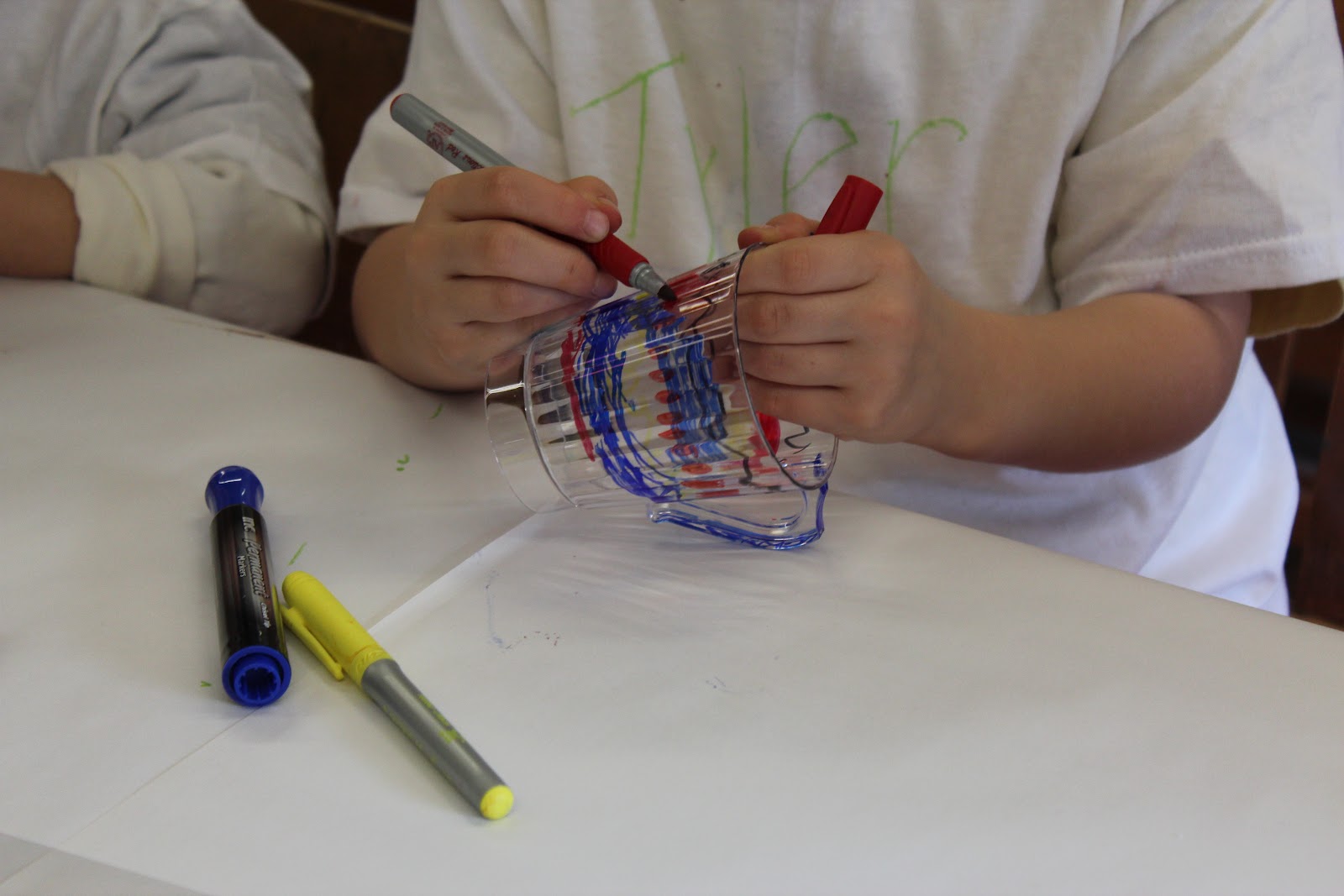
The second center was where students didn’t focus as much on the form of blown glass but they focused on the color, pattern and designs that are created within blown glass. Here students used markers to color plastic cups and shrinky dink.


The third center was where the plastic cups and shrinky dink was melted. 


Since we had concluded that the behavioral issues from the previous week were from boredom and not enough challenge, we created the fourth center for those who need more responsibility and challenge in the classroom. At this center, students were able to plan, design and create the class blown glass chandelier. Once the melted plastic had cooled, the pieces were brought over to this station where some of the older students (Ripley, Max and Jack) were drawing out the shape and plan of the chandelier. This was a great hands on experience for the students, they were able explore, manipulate and actually experience the 3D aspect of blown glass sculptures.


What We Learned:

1.   Rules and Expectations- Although we tried to remind the students of our class rules, they still seem to forget them. Students were often talking over each other during class discussions. This was the first week that we really had an issue with clean-up as well, especially after snack. We must remind students that if they choose to make a mess, they are responsible for cleaning up after themselves.
2.  Melting Center: As expected, students were extremely interested in watching their plastic melt in the toaster oven. While it was great for students to see the melting process, they seemed to forget that our toaster oven was extremely hot. Brandon almost put his entire hand on the 350 degree toaster oven. If we use a toaster oven again, we would tape a box on the floor to keep students a safe distance away from the toaster.
3.  Snack: While the clean-up from snack was a mess, another issue was that this week every student decided that they were extremely thirsty. We made the mistake of giving one student an extra juice box and then everyone else wanted one too. Next time students are thirsty, we will offer them a cup for water once they finish their juice.
4.   Ripley: After viewing Ripley’s amazingly advanced drawings in her sketchbook, we asked her how old she was. This week we learned that Ripley is 7 years old. While she seems content in our classroom we need to be conscious of giving her some more challenges or responsibilities in the classroom if she seems to become bored with what we are doing in class.

What Worked:

1. Students never seemed to be unoccupied. This week studio centers really helped the students find something that really interested them and enabled them to learn and explore blown glass in their own way. It would be interesting to keep providing different learning approaches to a topic we present to our students.
2.Parents. Finally the parents decided to leave our classroom. Throughout the past few weeks Brandon has been really upset and would not leave his dad’s side in the classroom. This week his dad left the classroom and once he was gone Brandon was content, enjoyed the projects and really opened up to us. We have learned that it is typically the parents who are afraid of leaving their children rather than the children being afraid.
3.This week we really tried to budget our time so that we would have enough time for closure. Our time management really worked and the students completed what we had planned for them to and we also had enough time to discuss the lesson and then also introduce them to next week’s lesson.